
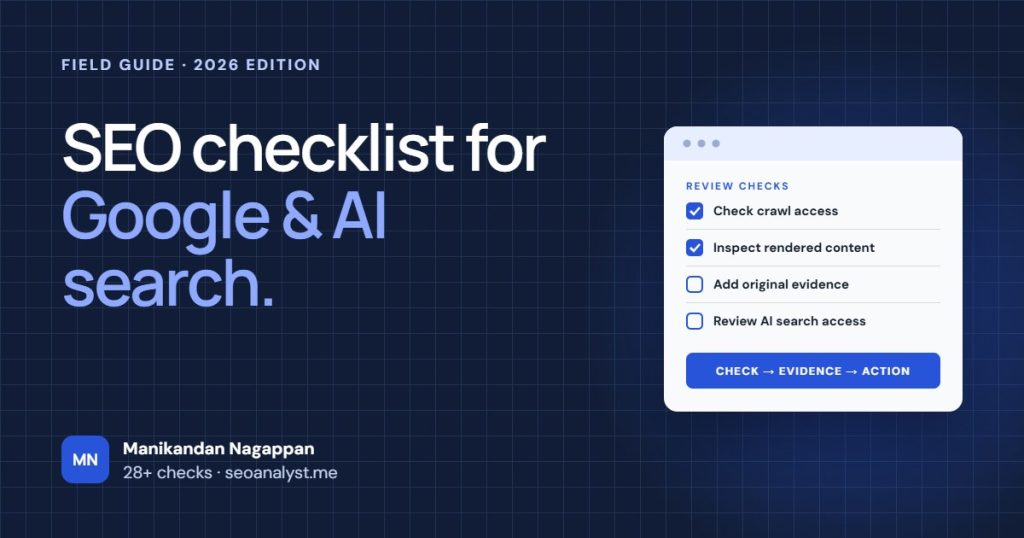
How-to / Field guide / 2026 edition
SEO checklist for Google & AI search.
Know what to check, how to verify it, and what to fix next. A practical guide to technical SEO, original content and AI discoverability.

By Manikandan Nagappan · Enterprise SEO, AEO & GEO
A checklist becomes useful when it changes your next decision. This guide connects technical access, content quality, trust and AI discovery with evidence you can inspect. Start with your important pages, investigate the relevant checks, and leave with a short action plan.
The working method
Check → Evidence → Action. For each finding, record what you inspected, what supports it, and what should happen next.
Start with a decision worth improving.
Before opening a crawler, choose a small set of pages that matter to your business. Write down who each page serves, what it should help them do, and what would count as a useful result. An enquiry, a subscription, or a completed product comparison provides more direction than a general wish for more traffic.
My recommended starting point is a dated baseline: priority URLs, available search data, and a tested conversion journey. When traffic is sparse, record what you can establish and leave unknowns visible. A lack of data is a reason to investigate carefully, not evidence for a confident performance diagnosis.
Can your important pages enter the search journey?
Google needs access to a working page with indexable content before it can consider that page for Search. Check response codes, robots rules and indexing directives separately. A successful crawl does not prove that a URL is indexed, and an indexed page is not guaranteed to rank.
Compare your crawl with URL Inspection and the intended page behaviour. For JavaScript sites, inspect the rendered content and important links; a browser looking correct is only one part of the evidence. Align sitemap entries, internal links and canonical signals around the intended preferred URLs. When findings disagree, preserve the URL and the evidence before proposing a change.
Worked example
A warning needs a reason.
A guide URL returns 200, but declares another page as canonical. What should you do?
Save the requested URL, response code, canonical target and inspection date. A 200 response alone does not establish the preferred indexed URL.
Give the reader something worth finding.
A content gap becomes useful when it exposes an unanswered need. Start with the decision the reader is making: what must they understand, compare, trust or do next? Then inspect the page for missing explanations, supporting evidence and practical limitations. My preference is to write the missing answer before deciding whether it needs another page.
Use search queries, customer language and relevant competitor pages as research inputs. Google describes query fan-out as related searches generated by a model; it does not provide a complete public list for your topic. Treat your own related-question map as a hypothesis, and avoid creating a separate page for every variation. Add an original example or method where you have one, and state its scope. Google recommends checking whether content adds meaningful value beyond other available sources.
Make the page easy to follow and place in context.
Use a descriptive title and a useful summary that accurately represent the page. Organise the content with meaningful headings, readable paragraphs and images that explain something. Write alt text according to an image’s purpose rather than filling it with target phrases. These choices support a clear reading experience.
Link to the next genuinely useful explanation with descriptive anchor text, and check that important links are crawlable. Make people, organisations and subjects explicit where they matter; avoid inserting entity names without a reason. If structured data is appropriate, ensure it represents the visible page accurately and validate it. Correct markup supports eligibility for relevant features; it does not guarantee an appearance.
Test the visit, including what happens after the click.
Review the page on a real mobile device. Can someone read it comfortably, use the controls, dismiss overlays and complete the intended action? A fast initial load cannot compensate for a form that fails or an interface that becomes difficult to use.
For Core Web Vitals, the good thresholds are LCP at or below 2.5 seconds, INP at or below 200 milliseconds, and CLS at or below 0.1, assessed at the 75th percentile and segmented by device. Field data reflects real visits; lab diagnostics help investigate causes. If field data is unavailable, say so. My recommended review pairs available performance evidence with a recorded mobile task test.
Let readers inspect the reasons to trust you.
Show who created the content and why their experience is relevant. Support consequential claims with suitable sources, explain your method and separate observation from interpretation. A short demonstration can communicate expertise more effectively than an unsupported adjective in a biography.
Google describes experience, expertise, authoritativeness and trustworthiness as E-E-A-T, while clarifying that E-E-A-T itself is not a specific ranking factor. My editorial standard here is simple: a reader should be able to identify the author, trace important claims and understand the limits of an example. Relevant external recognition can add context when described accurately. An industry mention should never become an invented endorsement.
Review each search surface on its own terms.
For Google’s AI search features, begin with its current eligibility and content guidance. There is no special AI schema requirement. Google also states that llms.txt is not used to improve Google Search visibility. These statements describe Google; they should not be generalised to every service.
Review crawler controls by purpose. Googlebot and Google-Extended address different uses. OpenAI separates OAI-SearchBot for search from GPTBot for potential training use; Anthropic likewise documents distinct search, training and user-triggered agents. Record the access policy you intend before editing robots.txt or firewall rules. For visibility research, save the question, date, service and cited URLs. A small prompt sample is an observation, not a reliable measure of your entire market.
Give automation a boundary and a review point.
My working principle is that AI should learn to operate trusted SEO tools. A bounded starting workflow is to supply a crawl export, ask an assistant to group suspected issues, and require it to return the source URL and evidence for every recommendation. Review the findings before creating implementation tasks.
Test the workflow against a manual review and note any missed issues or unsupported conclusions. Separately, browser agents benefit from understandable controls and stable interfaces. Current web.dev guidance discusses semantic elements, accessible labels and WebMCP, which remains in active development. Keep emerging capabilities in a test plan until they fit a real need.
Finish with three decisions you can defend.
Choose three actions using the affected page’s importance, the strength of the evidence, the likely impact and implementation effort. Treat an access failure on an essential page differently from an optional experiment. Give each action an owner and a clear verification step.
After implementation, confirm the intended technical or content change before looking for performance effects. Google now documents dedicated generative AI visibility reports in Search Console. Combine available search evidence with meaningful actions, and avoid causal claims from small samples. A ticked box means you investigated the check, not that a ranking or citation is secured.
Three useful questions.
Do I need separate SEO, AEO and GEO checklists?
Use a shared foundation for useful content and technical access, then add platform-specific checks. Google treats optimisation for its generative search features as part of SEO. Other services have their own access controls and behaviours, so keep those differences explicit.
What should I fix when my site has little traffic?
Verify priority-page access, confirm the content serves a real need, and test the intended user action. Record a baseline. With a small sample, focus on demonstrable fixes and avoid claiming that a short-term movement proves success.
Can AI run an SEO audit without human review?
It can assist defined tasks, but review the evidence, context and proposed changes. Ask for source references, sample-check the output and record failures. An automated summary should remain a review input until its recommendations have been verified.
Choose three fixes you can explain. Keep the evidence, assign the next action and decide how you will verify the result. The workbook below gives you a place to record that reasoning and return to it.
Take the method with you
Your next audit. A clearer evidence trail.
The printable workbook: every check, evidence prompts and a worksheet for your next three actions.
Questions about this guide?
Send me a note. I read every one.