
Experiment 001 / Agentic SEO / Content intelligence
AI Content Audit System: the audit that changes what I publish.
I built the content audit I wanted to exist. One URL and one topic go in, nine connected stages run, and a 17-slide report comes out. Then I used it to rewrite one of my own articles and watched what happened in Search Console.

By Manikandan Nagappan · AI SEO Expert in Chennai
Most content audits end at a score or a keyword list. I wanted one that ends in an editorial decision, so I connected crawlers, language APIs, embeddings and an AI assistant probe into a single workflow. Below you can run it, open the report it produced, see what happened when I applied it to my own article, and learn how to build your own.
What is the Content Intelligence Automation Framework?
The Content Intelligence Automation Framework is my method for turning one page URL and one topic into an evidence-backed content decision. Crawlers, language APIs, embeddings and an AI assistant probe run as nine connected stages and finish in a 17-slide report that shows where the page stands, what it is missing and what to fix first. The working version is the AI content audit system you can run below.
The idea behind the experiment
Most audits identify gaps. I wanted one that changed what I publish. The score is not the experiment. The experiment is whether the score leads to a better page, and whether I can observe what happens next.
Three questions that guided the build
Can one URL and a topic reveal real gaps?
Not a keyword list: the entities, phrases and questions a complete answer needs.
Can an agent turn gaps into priorities?
Editorial decisions a writer can act on, not keyword stuffing.
What happens when I apply it to a live page?
I tested it on my own article and tracked the result in Search Console.
What happened when I ran it on my own article?
I used my log file analysis for SEO guide as the test subject. The audit showed me what the page was missing, I rewrote the guide around those findings, and the refreshed version went back live on the same URL.
01 · The audit found the problem
An on-topic article that needed much stronger answers.
- Correct accuracy-sensitive and outdated guidance
- Expand the practitioner workflow with verification steps
- Strengthen direct answers, supporting entities and technical terms
- Turn a generic tool list into decisions an SEO can act on
02 · The content went back into the world
From an audit deck to a published technical SEO guide.
Log file analysis for SEO and AI crawlers
Googlebot verification · crawl waste · orphan pages · AI crawlers · diagnostic workflows
- Content depth: step-by-step diagnostic examples
- Search intent: question-led sections with direct answers
- Topical clarity: the entities and phrases the audit found missing
- Practitioner value: checks, methods and prioritisation
What are the four lenses behind the audit?
The framework looks at every page through the same four lenses, so two pages are always compared on the same terms. Words find the language leaders share. Entities find the concepts a complete answer names. Meaning checks the page is on topic. Answers checks whether AI assistants read and cite it. Select a lens to see what it extracts.
Content Intelligence Automation Framework · Lens 01
Not keyword density. Missing language.
I look for the terminology practitioners and leading pages use, then check where precise language helps the reader finish a task. The output is a phrase table and question wording I can reuse as headings.
Stage 4 · Slide 7
Content Intelligence Automation Framework · Lens 02
What does a complete answer need to mention?
I map the entities a topic depends on and sort them into covered, thin and missing. That separates genuinely missing concepts from name-dropping.
Stage 3 · Slide 6
Content Intelligence Automation Framework · Lens 03
On topic is a starting point, not a verdict.
Embeddings compare the page with the topic and with the benchmark set. I use that as an off-topic check, because similarity alone does not measure usefulness or quality.
Stage 5 · Slide 4
Content Intelligence Automation Framework · Lens 04
Does the page answer what assistants are asked?
I ask an AI assistant a fixed set of ten questions the page should own, log which sources it reads and cites, then look for answer-ready evidence: definitions, examples and passages that can be lifted cleanly.
Stage 8 · Slides 8–10
How does the audit run, from URL to report?
Start the sample audit and watch the nine stages run, or select any stage to see what it asks, which tool does the work and where its output lands in the report.
Interactive · Sample audit
Run the audit
One page URL and one topic go in. A report comes out.
This walkthrough replays the sample audit. To audit your own page, send me the URL.
- Waiting for input. Press Run audit.
Open the viewer, or select any stage above to see what it produced.
The nine stages as text
| Stage | The question it answers | Tool | What it produces |
|---|---|---|---|
| 1. Competitors | Which pages should this be compared against? | Custom script | A benchmark set of seven competitor pages. |
| 2. Crawl and extract | What text is actually on each page? | Screaming Frog, connected to Claude through MCP | Clean main-content text and word counts for every page. |
| 3. Entities | Which entities does a complete answer name? | Google Cloud Natural Language API | A coverage map: covered, thin or missing. |
| 4. Phrases | Which phrases and questions do the leaders share? | Custom script | An n-gram table and question phrasings for headings. |
| 5. Meaning | Is the page on topic? | OpenAI text-embedding-3-large | A semantic-alignment reading beside the competitor median. |
| 6. AI judge | How does a language model rate the page? | LLM judge | Five quality dimensions against the competitor average. |
| 7. Score | What is the single score, and how is it built? | Custom scoring model | A calibrated 0–100 score, a range and a rank. |
| 8. Assistant probe | Do AI assistants read or cite the page? | ChatGPT API | An AI-visibility table and citation-ready signals. |
| 9. Report | What does the client receive? | Search Console and a report generator | The 17-slide report as PDF and PowerPoint. |
What is Search Console showing for the refreshed guide?
This is the part I could not simulate. Between 6 and 12 October the guide averaged 15 impressions a day at an average position of 71.7. Between 13 and 22 October it averaged 42 impressions a day at an average position of 53.2, with 5 clicks. Hover or tap any point to read a day, and switch the chart between impressions and position.
One page, 6–22 October 2026
Source: Google Search Console performance data for seoanalyst.me/log-file-analysis-advanced-technical-seo-tips/, 6–22 October 2026, exported 23 October 2026. Position is Google’s average position, so lower is better.
This is one page over 17 days. It shows impressions and average position moving the right way after the audit, with a handful of clicks. I will compare equivalent windows, split query groups and track clicks and engagement before claiming a durable effect.
The full loop: from diagnosis to measurement
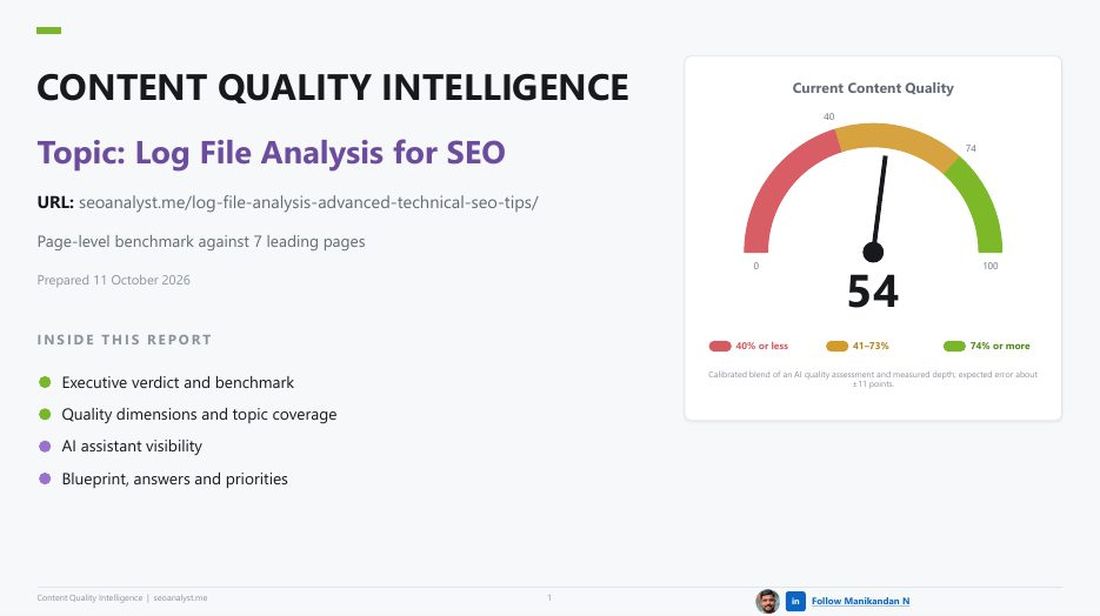
The initial run scored the guide 54/100 and placed it 8th of 8 in its benchmark, with weak direct answers, depth and trust signals. In the ten-prompt assistant probe the page did not appear. That was the brief for the rewrite.
The report pointed to outdated and accuracy-sensitive guidance, a missing end-to-end workflow, thin direct answers and a generic tool list. I fixed those first, ahead of marginal phrase gains.
The refreshed guide connects crawl issues and bot verification to real diagnostic questions, with defined terms, worked examples and prioritised actions. Read it to see the work itself.
Impressions and average position have moved the right way since the audit. I am treating that as an early signal and will next compare equivalent windows and query groups, then track clicks and engagement.
What does the audit produce?
A 17-slide report built for a decision. It opens with the verdict, explains the gaps behind it and closes with a prioritised fix list and a target to measure against. Search demand in the report comes from Search Console, which I cover in Search Console data at scale. These are the actual slides from the sample audit.
What each part of the report answers
Where does the page stand?
An executive verdict and a benchmark against seven leading pages, with what separates the leaders.
Open slides 2–3 →Slide 4Where does it fall short?
Five quality dimensions beside the competitor average, plus semantic alignment and freshness.
Open slide 4 →Slide 5Is there demand for it?
Search Console impressions, clicks and positions, and the queries already reaching the page.
Open slide 5 →Slides 6–8What is missing?
Entity coverage, shared phrases, question wording and the tasks assistants break the topic into.
Open slides 6–8 →Slides 9–10Do AI assistants use it?
Ten prompts, which sources won each one, and what makes a page citation-ready for this topic.
Open slides 9–10 →Slides 11–17What changes first?
SERP snippet, structured data, a content blueprint, answer blocks, priorities and a north-star target.
Open slides 11–17 →How do you build an audit system like this yourself?
You do not need my exact stack. You need the same sequence. Use this checklist to plan your own version, and tick each step as you work out which tool will cover it.
Once the nine steps are covered you have a working pipeline. If you would rather skip the build, I will run it on your page.
Questions about the experiment.
What is the AI content audit system?
It is my multi-step workflow that takes one page URL and one topic, compares the page with a set of leading competitor pages, checks entities, phrases and meaning, asks an AI assistant the questions the page should answer, and returns a 17-slide report with a score, the gaps and a prioritised fix list. I call the method the Content Intelligence Automation Framework.
How is it different from a typical content audit?
A typical audit ends at a score or a list of keywords to add. This one ends at an editorial decision. It benchmarks the page against named competitors, maps what is missing, tests whether AI assistants read the page, and ranks the fixes, so a writer knows what to change first.
What does “agentic” mean in this context?
Several steps run in sequence and each one’s output feeds the next. A competitor shortlist becomes a crawl, the crawl becomes clean text, the text feeds the entity, phrase and embedding checks, and an AI judge and an assistant probe sit on top. No single tool produces the result; the chain does.
What do I need to provide, and what do I get back?
The core audit needs a page URL and a topic. Search Console data, when available, adds the search-demand view. You get a 17-slide report as a PDF, with an editable PowerPoint version, covering the benchmark, the gaps, the AI-visibility probe, schema checks and a prioritised fix list.
Can I implement this myself?
Yes. Nothing in the pipeline depends on a private tool, and the build-your-own checklist above lists the sequence. You need a crawler with custom extraction, an entity API, an embeddings API, access to a language model, and a little scripting in Node.js or Python to pass each step’s output to the next. Budget time to calibrate the scoring against pages you have rated by hand, because it is the step most people skip.
Which tools were used for this experiment?
Screaming Frog, connected to Claude through MCP, for crawling and main-content extraction, so the crawl feeds the later stages without manual exports; the Google Cloud Natural Language API for entities, OpenAI’s text-embedding-3-large for meaning, a language-model judge for the five-dimension assessment, the ChatGPT API for the assistant probe, Google Search Console for search demand, and custom scripts to select competitors, mine phrases, score pages and assemble the report.
How is the content-quality score calculated?
The score is a calibrated blend of an AI quality assessment and measured depth. The report shows it with an indicative range because the expected error is about 11 points, so small gaps between pages should not be over-read. It is an internal audit score, not a Google metric.
How are the competitor pages chosen?
A shortlist of candidate pages for the topic is filtered on status code, word count, last-modified date and topical fit. The benchmark set is earned, not hand-picked, which is why the score is comparable across pages.
What does the 0 of 10 AI-presence result mean?
The assistant probe asked ten questions the guide should own. In the initial audit the page did not appear in any of the answers. It is a bounded observation for one topic at one point in time, not a universal AI-visibility score.
Did the audit cause the Search Console improvement?
It is too early to say. Impressions and average position moved the right way after the audit, but this is one page over a short window with a handful of clicks. I treat it as an early signal and will compare equivalent windows, query groups, clicks and engagement before claiming a durable effect.
Does a higher score guarantee better rankings or AI citations?
No. The score measures page quality against a benchmark set and is not a ranking factor. The assistant probe is a ten-prompt observation of which sources get read and cited, so I treat its signals as observations for this topic, not universal ranking factors.
Can you run this audit on my page?
Yes. Send me the page URL and the topic you want it to own, and I will run the same nine stages and share the same 17-slide report. Use the request button below or connect with me on LinkedIn.
Want this on your page?
Send me a URL. I’ll run it.
One page and one topic. You get the same nine stages and the same 17-slide report you just walked through.
Measuring content quality properly?
Send me the question. I read every note.