
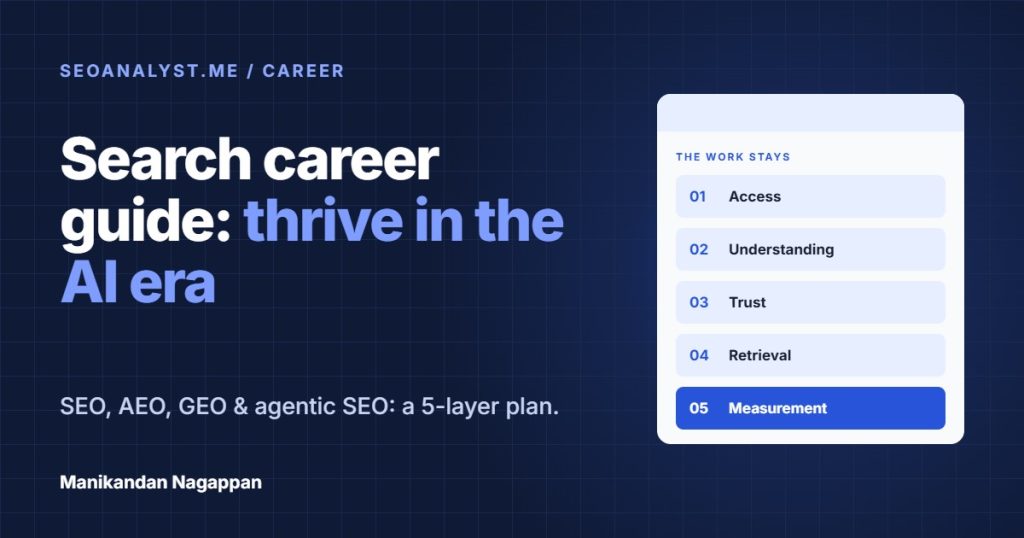
Career / AI search / Field guide
Search career guide: how to thrive in the AI era.
SEO, AEO, GEO, LLMO, agentic SEO. The job titles keep multiplying, but the work underneath them hasn’t changed much. Here’s a model, a skills check and a 90-day plan that stay useful whatever the next label is.

By Manikandan Nagappan · AI SEO Expert in Chennai
If you work in search, you’ve probably been asked whether you “do GEO” yet. This guide answers a better question: which skills will still matter when the next acronym replaces this one?
What does a career in search mean now?
A career in search means helping machines find, understand, trust and surface a brand, then proving the business impact. The labels for that work keep multiplying, but they describe shifts in emphasis, not separate professions. Google itself says optimizing for its generative AI features is still SEO.
The working method
Don’t chase the acronym. Build depth in five layers: Access, Understanding, Trust, Retrieval and Measurement. Every new title then becomes a variation you already know how to do.
Working SEOs
Deciding what to learn next, and how to position a career for AI search.
Beginners
Choosing where to start without betting on a label that may not last.
A model and a plan
A term map, Manikandan’s Framework, a scorecard and a 90-day plan.
Why does the job title keep changing?
Three things happened at once. Search moved from lists of links to generated answers in Google’s AI Overviews and AI Mode, ChatGPT, Perplexity, Gemini and Copilot. Software vendors needed category names to sell new tools. And hiring teams began writing those names into job descriptions.
The hiring data shows how far that has spread. An Omniscient Digital analysis of 643 unique North American SEO job postings found that 34% now require AI search skills, and 6% use entirely new titles such as “SEO & GEO Specialist”. A separate Semrush study of 3,900 SEO listings found that 59% were Director, VP or Head-level roles, and that digital PR appeared in about 13.5% of senior listings.
SEO, AEO, GEO, LLMO and the rest, decoded
There’s no consensus definition for most of these terms, and practitioners use them inconsistently. Treat this as a working map, not a standard.
| Term | What it emphasises | Where it fits |
|---|---|---|
| SEO Search engine optimization |
Ranking and visibility in search engines. | The foundation. Google treats AI search optimization as part of it. |
| Search Everywhere Optimization | Visibility across Google, AI assistants, video, marketplaces and social. | An umbrella reframing of SEO, used by Rand Fishkin and others. |
| AEO Answer engine optimization |
Being the direct answer in snippets, voice and chat. | The oldest new term; it grew out of featured snippets and voice search. |
| GEO / GSO Generative engine (or search) optimization |
Being cited or mentioned inside AI-generated answers. | Named in a 2024 KDD research paper; now the most widely used label. |
| LLMO Large language model optimization |
Brand presence across any LLM, search or not. | Broader than GEO. |
| AIO, AISO, AI SEO, GAIO | Umbrella labels for AI-driven discovery. | Agency and vendor labels; meaning varies by who uses them. |
| SXO Search experience optimization |
SEO combined with UX and conversion. | Older, still useful for landing pages. |
| Agentic SEO | Using AI agents to do SEO work. | A way of working, not a search surface. |
| Agent optimization | Making your site usable by AI agents that browse, compare and act. | Emerging, with no settled acronym yet. |
| AI visibility or brand discoverability |
Measuring how often and how accurately AI systems mention a brand. | The reporting layer behind most of the above. |
The confusion most guides miss: “agentic” means two things
Agentic SEO: agents work for you
LLM-powered agents run SEO workflows, such as data pulls, gap analysis and internal-link suggestions, with human oversight. Search Engine Land separates this explicitly from optimizing for AI search visibility.
Agent optimization: agents visit you
An agent comes to your site on a user’s behalf to compare plans, fill a form or complete a purchase. That rewards clean structure, usable forms, crawlable pricing and accurate product data.
A career plan needs both. One makes you faster; the other keeps your site usable by a new kind of visitor.
What Google said about AEO and GEO
In May 2026, Google published a guide to optimizing for its generative AI features. It acknowledges AEO and GEO as terms you may come across, then frames that work as optimizing for the search experience, “and thus still SEO.”
What it says to skip
llms.txt, content chunking, AI-specific rewriting and special schema for its generative AI features.
What it says to do
Unique, non-commodity content, plus SEO fundamentals: a page must be indexable and eligible to show with a snippet.
Two caveats that matter for your career
- The guidance covers Google Search only, not ChatGPT, Perplexity or Copilot.
- It doesn’t deal with off-site visibility, such as brand mentions in forums and video, which still shapes how other AI systems describe you.
So “it’s all SEO” is true for Google, and incomplete for the whole job.
Manikandan’s Framework: the five layers of search work
Titles describe where an employer wants emphasis. Layers describe the work. Every role in search, from a junior specialist to a Head of AI Visibility, operates across these five. This is my own model, not an official industry standard.
Manikandan’s Framework
Learn the layers, not the labels.
The rule: no layer works if the one beneath it fails.
Layer 01
Access
Crawling, rendering, indexing, site architecture, robots rules and AI crawler access. To appear in Google’s AI features, a page first has to be indexable and eligible for a snippet.
Real-world problem: a JavaScript-heavy site renders fine for Googlebot but serves near-empty HTML to AI crawlers that don’t run scripts. See the render gap analysis and log file analysis for AI crawlers.
Layer 02
Understanding
Entities, topical depth, clear definitions, structured data that matches the visible content, and internal links that show how ideas connect.
Real-world problem: a brand’s name is ambiguous, and AI answers confuse it with another company. The fix is entity work: one consistent name, description and set of relationships across your site, profiles and third-party sources.
Layer 03
Trust
First-hand experience, named authors with real credentials, original data, earned links, brand mentions and reviews. This is where digital PR earns its place in senior job descriptions.
Real-world problem: your page is accurate but interchangeable, and AI answers cite a forum thread instead. Original evidence, such as your own data or a tested method, is what makes a page citable. See backlink audit and link risk analysis.
Layer 04
Retrieval
Blue links, AI Overviews and AI Mode, chat assistants, voice, video, marketplaces and agent-completed tasks. Each surface selects and presents sources differently.
Real-world problem: you rank in the top three, yet the AI Overview cites two competitors. Retrieval work asks why: is your answer buried, unsupported, or missing the follow-up question the user actually had?
Layer 05
Measurement
Search Console, GA4, AI referral tracking, AI visibility monitoring, and turning all of it into pipeline and revenue language. Google points site owners to Search Console reporting for its AI features; for other assistants, measurement is still immature, which makes careful analysts more valuable.
Real-world problem: organic sessions fell but leads didn’t. Without measurement you report a decline; with it, you explain zero-click visibility and show where demand moved. See Search Console data at scale and regex for GA4 and Search Console.
How today’s titles map onto the layers
| Title you’ll see | Heaviest layers |
|---|---|
| Technical SEO | Access, Understanding |
| Content or AEO specialist | Understanding, Retrieval |
| GEO or AI visibility specialist | Trust, Retrieval, Measurement |
| Digital PR or brand SEO | Trust |
| Agentic SEO or SEO automation | All five, through tooling |
| Head of Search & AI Visibility | Measurement, plus judgment across all five |
What AI automates, and what it can’t
Agents are good at repeatable, data-heavy work: pulling rankings, clustering queries, drafting briefs, finding broken links and suggesting internal links. Hand those over. They are weak at the four things that now define seniority.
Judgment under ambiguity
Deciding which of twenty findings matters this quarter, and which can wait.
Original evidence
Running the test, talking to the customer, publishing data no model already has.
Influence
Getting engineering to fix rendering, or legal to approve a comparison page.
Accountability
Owning the number, and catching an automated change before it breaks Google’s spam policies.
The senior-heavy hiring mix is consistent with this: the routine layer is getting cheaper, and the judgment layer is where the roles are.
Score your skills across the five layers
Be honest. Your lowest layer is your next learning goal; your highest is your positioning.
Interactive tool
Five-layer skills scorecard
Pick the statement closest to what you can do today.
Your result shows your total, your gap and where to focus first.
A self-reflection aid, not a hiring benchmark.
A 90-day plan to build AI-era search skills
Use one real site, even your own. The goal by day 90 isn’t a certificate. It’s one documented case study you can show in an interview.
- Days 1–30 · Access + Measurement
Audit and instrument
Check indexing in Search Console, run a crawl, compare raw and rendered HTML, and review which AI crawlers your robots rules allow. Set up a GA4 segment for AI assistant referrals. Use the SEO checklist for Google and AI search as your scaffold.
- Days 31–60 · Understanding + Trust
Publish one citable page
Pick a topic you know well. Answer the main question and its follow-ups, backed by something original: a test, a dataset or a worked example. Add structured data that matches the visible content, then earn one external mention for it.
- Days 61–90 · Retrieval + proof
Track, then write it up
Run the same 20 prompts in Google AI Mode, ChatGPT, Perplexity and Copilot every fortnight, and log who gets cited. Then write a one-page case study: what you changed, what moved and what didn’t.
How to prove your search skills
A public case study
Problem, evidence, change and outcome, including what failed. It shows judgment, which a credential can’t.
A small original dataset
A prompt-tracking log or a crawl comparison demonstrates Trust and Measurement at once.
Certifications
They help beginners pass screening, but rarely decide senior hiring.
Your headline
“SEO & AI Search” reads as current without betting your profile on one acronym surviving.
Do SEO conferences help your search career?
Yes, if you go with a plan. A conference won’t teach you the five layers, but it shortens the gap between what changed and when you hear about it, and it puts you in a room with the people who hire, refer and cite.
BrightonSEO
One of the largest SEO-only conferences, held in the UK and San Diego. Useful for hearing practitioner case studies, not vendor pitches.
Search Central Live
Google’s own events for site owners and SEOs. In 2026 it returned to India with a Bengaluru edition, a rare chance to put questions to Google’s search team in person.
Local SEO and SaaS meetups
India-focused conferences and community meetups, many with a SaaS growth angle. Smaller rooms make it easier to meet peers and hiring managers.
How to turn an event into career evidence
- Before: pick two sessions that match your weakest layer, and two people you want to meet.
- During: ask one specific question tied to a real problem you’re working on.
- After: publish a short write-up of what you’ll test. That post is a Trust artefact, and it’s often what gets you remembered.
- Next level: apply to speak once you have a case study. Speaking is a strong credibility signal for senior roles.
Search career questions.
Is SEO dead because of AI search?
No. Google says optimizing for its generative AI features is still SEO, and job listings are adding AI search skills to SEO roles rather than replacing them.
Should I call myself a GEO specialist or an SEO specialist?
Use both where it helps people find you. “SEO & GEO” or “SEO & AI Search” matches how new job titles are being written, without depending on one label lasting.
What’s the difference between AEO and GEO?
AEO focuses on being the direct answer, a legacy of featured snippets and voice search. GEO focuses on being cited inside AI-generated answers. In practice the work overlaps heavily, and many people use the terms interchangeably.
Is agentic SEO the same as AI SEO?
No. Agentic SEO means using AI agents to do SEO work. AI SEO, often called GEO, means optimizing to appear in AI-generated answers.
Do I need llms.txt for AI visibility?
Google says it isn’t needed for its generative AI features. Other platforms haven’t made firm commitments either way, so treat it as optional and low priority.
Can a beginner start directly in AI search?
You can, but you’ll stall without Access and Measurement skills. Most AI visibility problems trace back to whether content is reachable, understood and trusted.
Which search skills will pay off longest?
The ones no tool can fake: original evidence, technical diagnosis, and the ability to connect search performance to revenue.
Are SEO conferences worth it for career growth?
They are when you go with a plan: pick sessions for your weakest skill, meet specific people, and publish what you’ll test afterwards. Google’s Search Central Live, BrightonSEO and India-focused community events all offer this.
Take the method with you
Learn the layers, not the labels.
Download the five-layer scorecard and 90-day plan as a CSV, with three sample rows to show how to fill it in.
Keep reading
 How-to · Field guideSEO checklist for Google & AI search28+ checks for access, content quality, trust and AI visibility, with a workbook.
 How-to · Search ConsoleSearch Console data at scale: export it, query it, trust itExport more than 1,000 rows, set up BigQuery and run 12 SQL investigations.
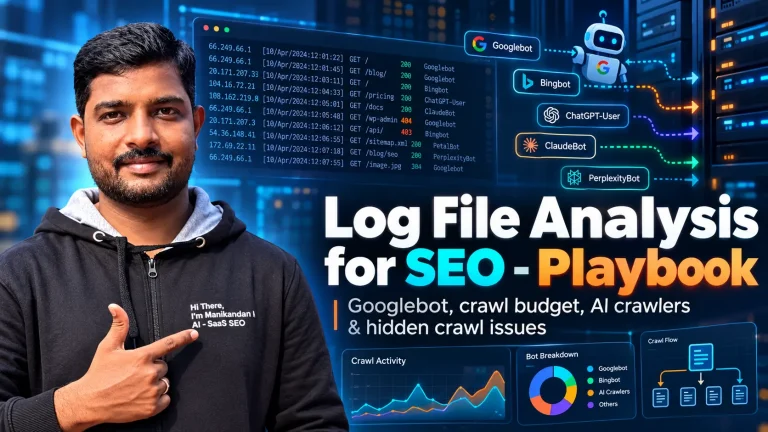 Technical SEO · Deep diveLog file analysis for SEO and AI crawlersVerify Googlebot, find crawl waste and check which AI crawlers reach your site.
Planning your next move in search?
Send me the question. I read every note.
I like the way you write with Emojis.
The way you have described.. is awesome. I liked it very much and learned so many things. I am a beginner digital marketer and I read a bulk of articles and blogs but I got same kind of information and same way of delivery which makes me feel bored. But I have found a pretty interest on your blog. Thank you for sharing such wonderful things, it really helpful for beginners like me. Please provide more blogs like this related to SEO.